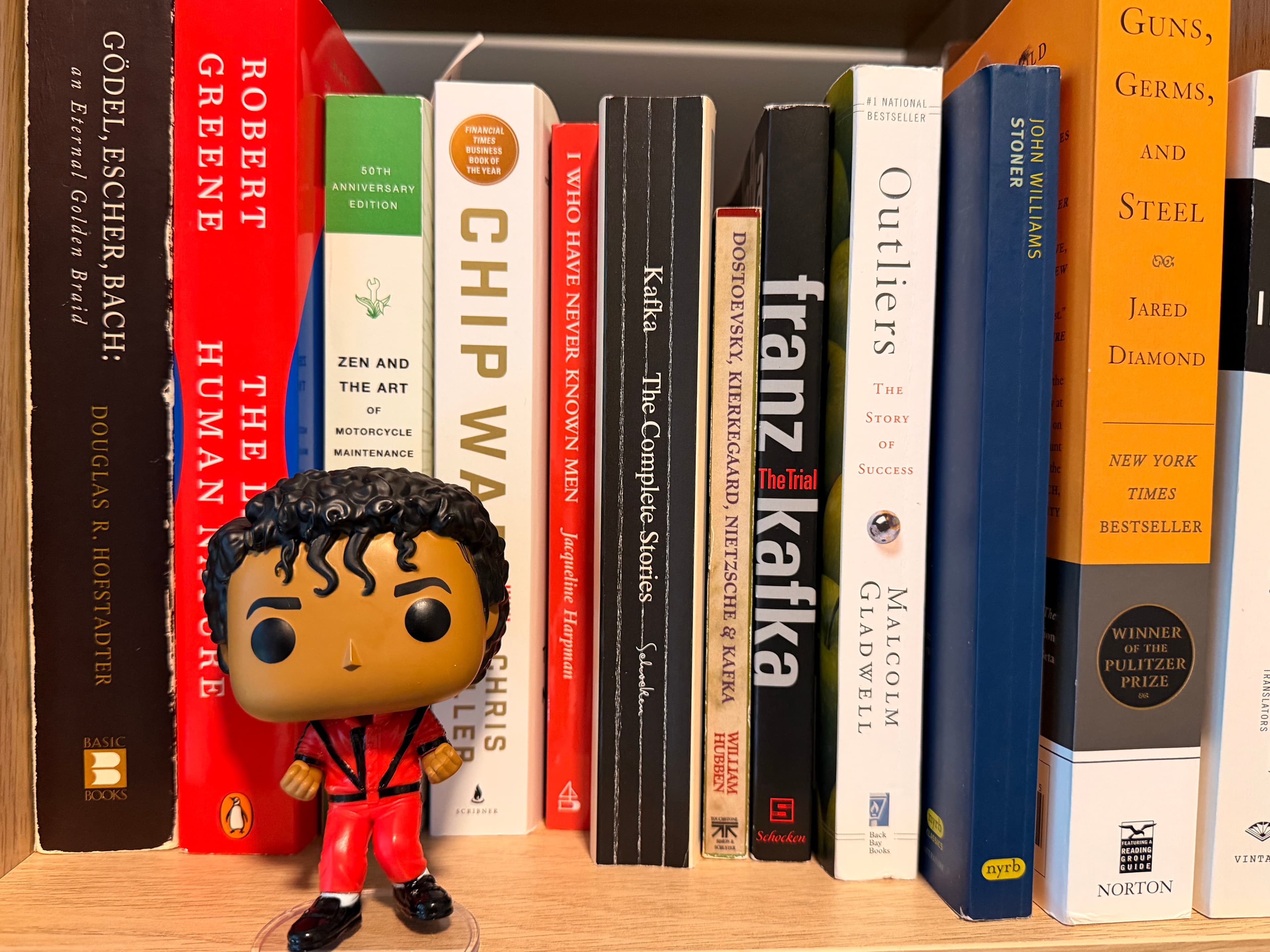
Recently, I've had the chance to get back into reading. It's something I've held as being very important to me since childhood, but with school and activities, it's difficult to find the dedicated time to actually be able to pick up a book and sit with it for a good while.
Getting a job 1.5 hours away from my apartment (on Ottawa public transit nontheless) can feel like a punishment sometimes. Of course, on the bright side, being stuffed in an overcrowded, musty train/bus for a good while really does grant you some much needed reflection time. I wanted to share some of the books that I've been able to read recently and my thoughts on how I want to incorporate it more into my life as I enter a new chapter going forward.
In total, since June, here is a comprehensive list of all the books that I've had the chance to read, in no particular order:
| Title | Author |
|---|---|
| Into Thin Air | Jon Krakauer |
| Stoner | John Williams |
| The 48 Laws of Power | Robert Greene |
| The Myth of Sisyphus | Albert Camus |
| The Complete Stories | Franz Kafka |
| Outliers | Malcolm Gladwell |
| The Let Them Theory | Mel Robbins |
Let me tell you, it has been an absolute treat. Reading books that aren't thick, intellectually dense stacks of paper filled with incomprehensible Greek characters and circuits? Count me in.
I'll admit, this isn't a measly roster. These books have definitely made me think, and they aren't the kinds of modern-day AI-generated slop that a lot of lazy publications will put out for a quick cash grab. I've selected this bookshelf very deliberately to bridge the gaps in my knowledge, improve myself mentally in some way, and explore my interests further.
Into Thin Air was a particularly fascinating read for me. I'm very interested in high-altitude mountaineering, and in particular, I consider myself to be a little bit too knowledgable when it comes to the discussion of incidents that have taken place on the world's 8000 meter peaks - that definitely includes Everest. In his book, journalist Jon Krakauer recalls his experience as one of the victims of the 1996 Everest Disaster where the absolute unthinkable occurred. Between 12 - 15 people died on the mountain that fateful series of days in May 1996. Krakauer details, in an elegant and raw prose, the suffering he went through so far removed from humanity, and the absolute dread that comes with the guilt of being a survivor. It is a gritty, contemporary study of human nature that I couldn't have enjoyed more. A fascinating account that, I must say, makes me pretty happy that I spend most of my time at sea-level.
The 48 Laws of Power is a book that, if you ask any of my relatives, drives them crazy. It isn't because Robert Greene is a bad writer - quite the contrary. He's in fact so good that I read the entire whopping 452 pages in all but a week. On top of that, the pages are littered with my chicken scratch comments and bright pink sticky notes from just how much I had to say and learn from his writing. I don't want to speak on it too much, because I think this is one of the books that everyone should read before they kick the bucket. It's a book that you can interpret as you wish, and take into practical account (obviously negating the parts about literally killing your enemies, although I can admittedly see why that is tempting). The best way to describe it, I think, would be with the very quote featured in its postscript:
"Man will only become better when you make him see what he is like" - Anton Chekhov
I couldn't have said it better. The best way to understand ourselves must be by accepting that we have inherent flaws and that, instead of working against them and pushing through life as if they aren't there, taking the time to study ourselves and exploit our weaknesses (and the weaknesses of others) to our advantage is a good thing. Easier said than done though, am I right?
I find that my education and career fields are both so laser-focused on sanitizing myself of my humanity and focusing on producing results and innovating. There isn't room for writing or poetry or art. I sometimes see students in liberal arts programs, and I think of the movie Dead Poets Society. I envy them to some degree, yes. Because at the end of the day, ultimately, we need humans and we need art. Art makes us feel things, we all know that. But what I think we don't realize is that being in tech isn't meant to be a dry field. It doesn't mean that we need to completely give up creativity and spend all day typing away lines of code like zombies. There's still room for art and emotion and feeling. It's hard to see it, and I admit I haven't found it yet. But I want to keep looking. I don't want to just read stories.
I guess what I'm trying to say is that I want to feel the stories I'm reading. Maybe I don't want to be on Mount Everest, but I do want to find beauty in the natural occurence of the Fibonacci sequence. I want to be able to build a creative project where, after you solder it down onto your board, somebody goes "Woah! This will change lives!" Not in the sense of 'this will change OUR lives by letting us sell this for a huge profit', but something along the lines of an innovation really helping enrich someone's quality of life. I don't want to be an engineer or a computer scientist who has no interest in studying humans. After all, do you ever think about the fact that these tech jobs wouldn't have existed (or been easy to explain) 100 years ago? This is all man-made. I know that usually has a negative connotation, but maybe I can find away to convince at least myself that it doesn't need to be so dry.